T-House Instructions
HO Scale Residential Duplex
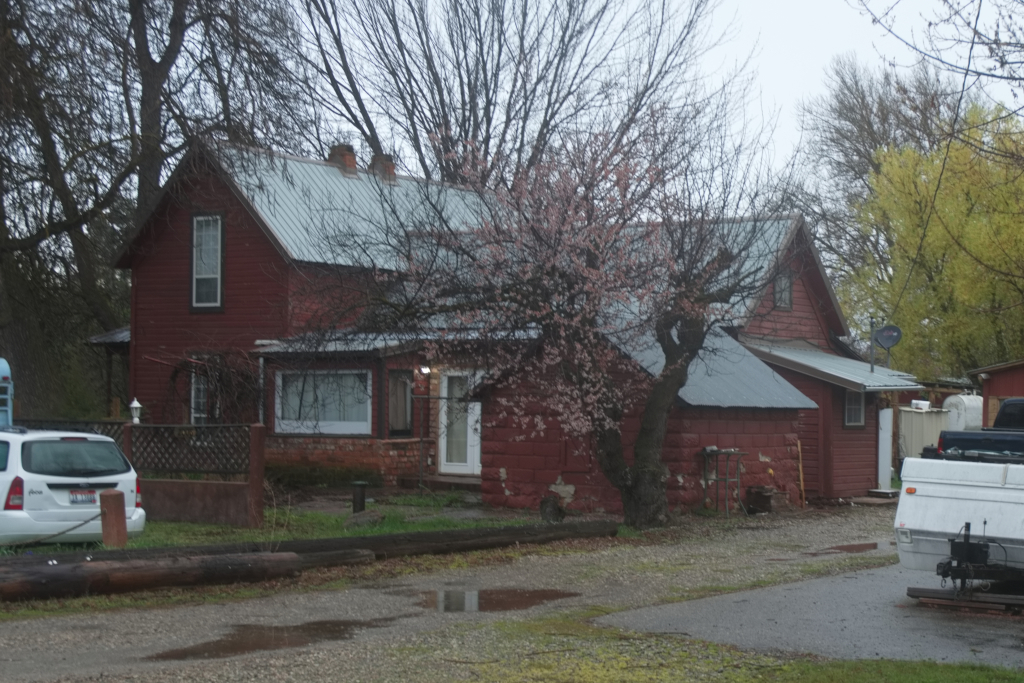
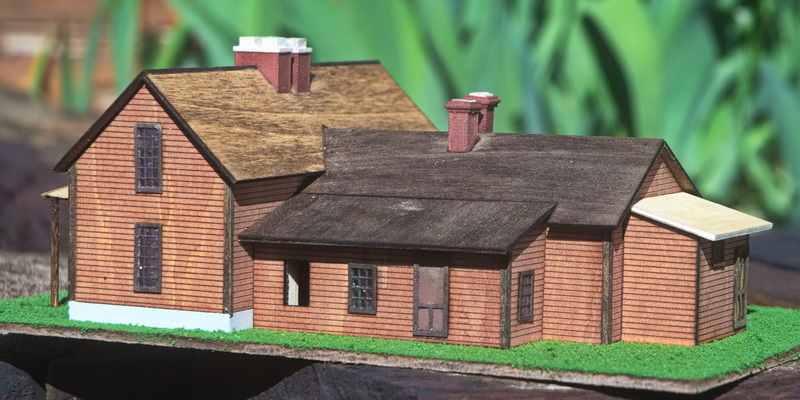
The name “T-House” comes from the shape of the original footprint. Although there are no windows or doors cut into the back section walls of the kit, the structure can be completed with the original footprint by leaving off the additions and mud room. It was a duplex and fixtures would have been mirrored on each side.
Built as a duplex in 1910, this structure now exists as a single family residence. Currently listed as a 2000 sq ft, 4 bedroom, 2 bath residence, later additions have been added to both sides of the back section increasing the structure from the original 800 sq ft for each side.
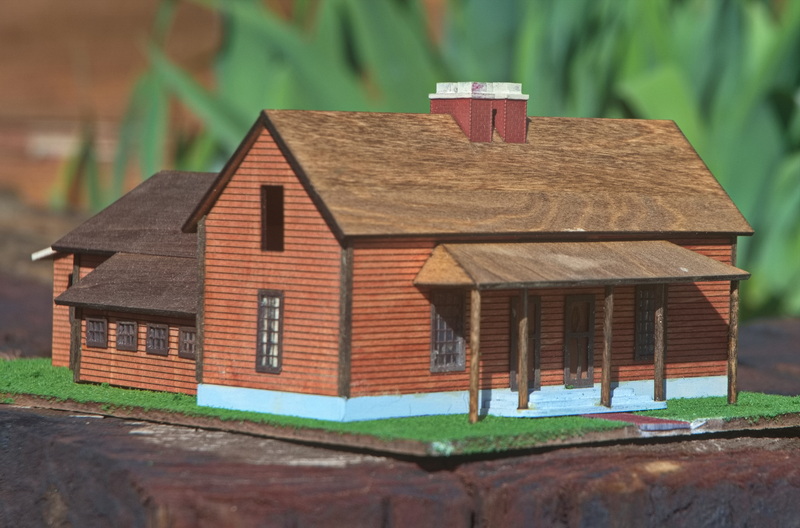
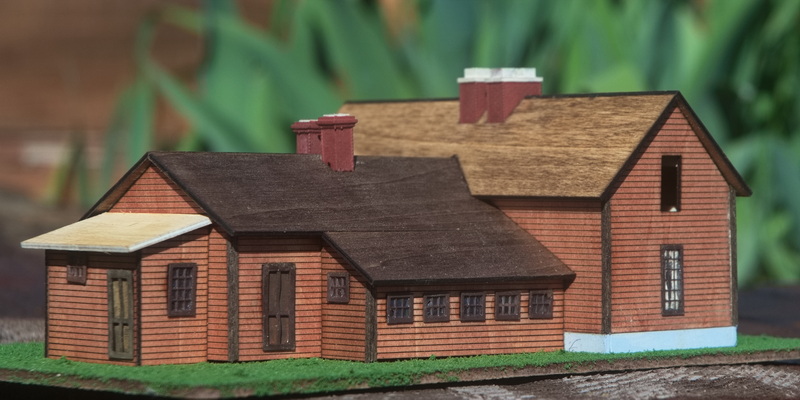
The present structure is barn red with brown trim and white doors and window frames. The roof is grayish corrugated tin. The original color is unknown – perhaps as it is now; the roof was originally wood shake.
The kit includes a sheet of uncut acetate for glazing but does not include roofing material as these are individual modeling choices. It is believed the original roof was shake shingles; it is now painted corrugated tin.
T-House Parts
The unlabeled laser-cut parts are identified here. The etching of these walls is not shown; the labels are not printed on the actual parts.
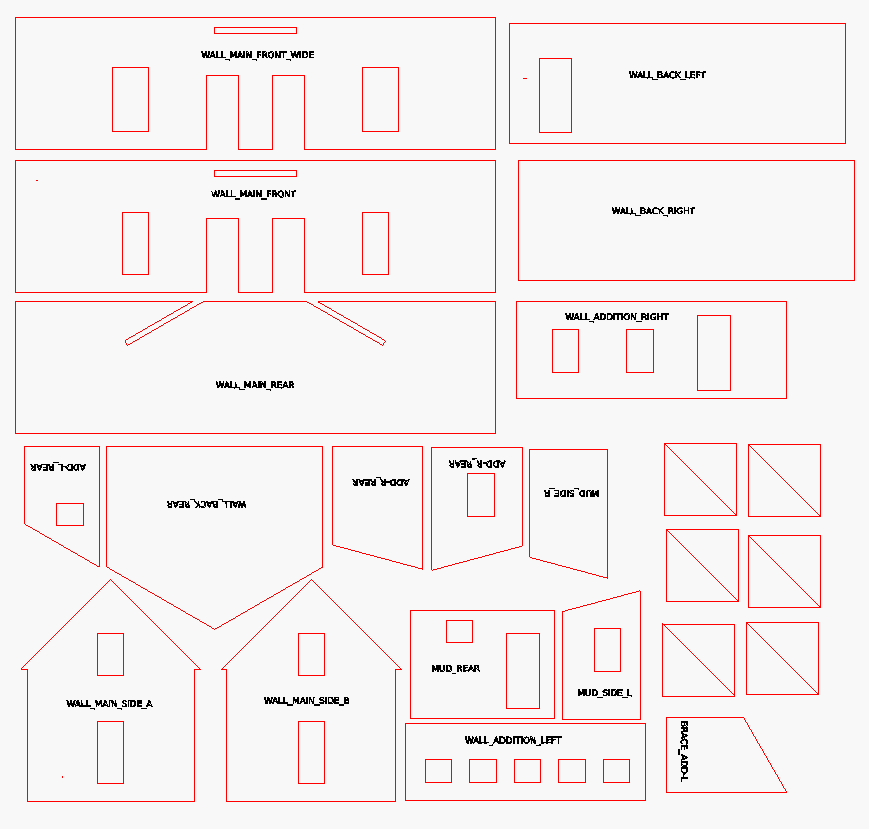
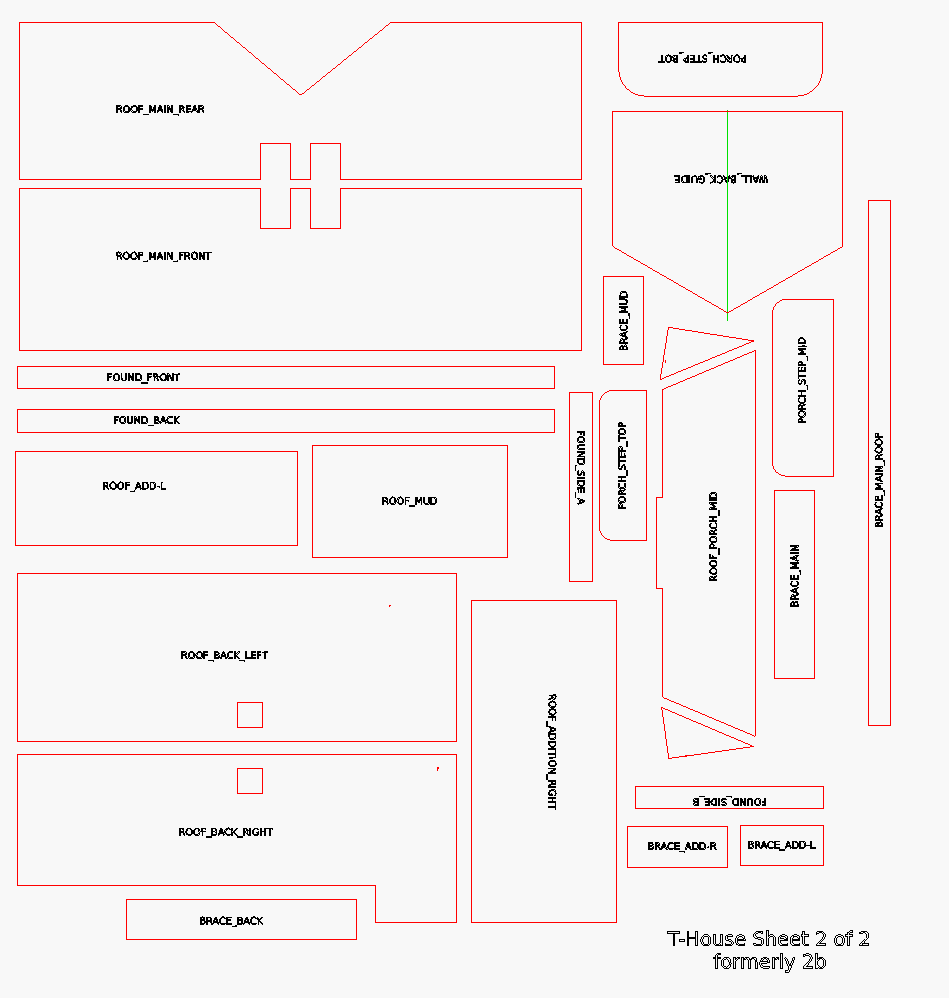
The remaining parts are bagged as follows:
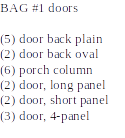
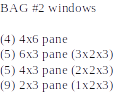
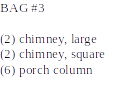
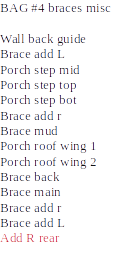
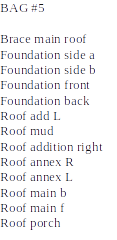
PREPARATION
The structure is built of laser-cut 1/16” plywood. 1/16” is equivalent to 5.44” in HO scale – roughly the thickness of the prototype wall. Windows and doors are 3D-printed resin. While somewhat fragile, this material may be sanded or drilled as desired. Proper ventilation while sanding is a must – personally, I choose not to chance breathing resin dust (nor paint fumes and glue for that matter).
Arguments can be made for various methods of preparation. Prepare/paint the walls before assembly. Or, assemble common parts then paint the assembly. Or, just build it and spray paint the whole thing when done ….
The construction steps are presented; the modeler can apply an assembly method of individual choice.
The thin wooden walls tend to warp when painted or stained. Using an alcohol rather than water-based thinner reduces the swelling but if warped, wet one side of the wall, place on a flat surface and weight the wall down until dry. Be careful the flat surface does not cause stains or marks on the wall. The interior is not intended to be visible; bracing across the grain will help keep the walls flat.
Construction glue such as Tite-Bond is used for wood-wood connections. Clear Gorilla Glue is a good choice for fastening the printed resin parts, regular 2-part epoxy also works well for the resin parts. Superglue works with the resin parts but sets quick and usually doesn’t allow time for “tweaking”. The resin is not styrene – most “plastic” glues will not work (including MEK).
Roofing material is often applied with double-sided tape – but if a mistake is made, it may be difficult to fix without causing damage. A wash of 1:1 or 1:2 white glue (Elmer’s) added to water as “paint” can be used to fasten some roofing materials. Aleens Tacky Glue also works and is not as messy.
While the base roof is supplied, the roofing material itself is not.
[The symmetry of these pieces allows a structure to be constructed without the etching on the outside walls. The only difference to the structure will be the left and right location of the two side additions – which are not identical]
Construction
PART 1 – MAIN STRUCTURE – The top part of the “T”
There are two front walls included with this kit – one with narrow windows, one with wider windows. The present structure has asymmetric windows – the original 3×6 pane on the right; a larger 4×6 equivalent (The two middle panes are a single pane of double width). Both size windows are provided; to model the current structure will require trimming the left-side window of the narrow-window wall to the larger size.
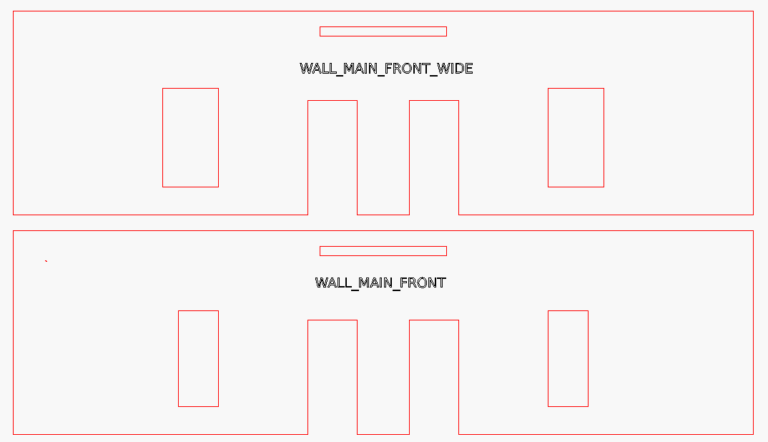
1) Find and fasten FOUND_FRONT to the bottom of the chosen front wall – the wall sits on top of the foundation. Do the same for the back wall (with slanted cutouts) using FOUND_BACK. ( FOUND_FRONT and FOUND_BACK are identical)
2) Do the same for the side walls – the two walls are identical. Fasten FOUND_A and FOUND_B – also identical – to those walls.
The foundation pieces are a bit thicker than the walls. The outside face of the walls can sit flush with the outside wall of the foundation or sit back an inch or so by making the back of the wall flush with the back of the foundation.
Clamps:
“Backwards” wooden clothespins work well here
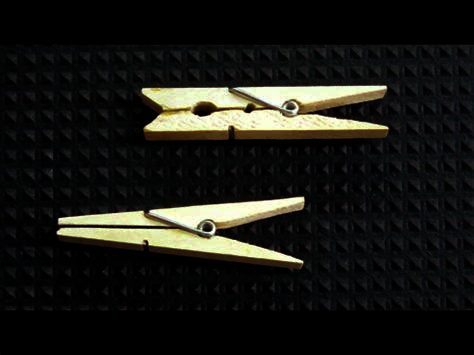
When opened, they match the clamped walls at almost a flat 90 degree angle.
4 clamps per wall isn’t too many. 6 might be.
3) Fasten the side walls to the front and back walls – I find it easiest to fasten one side wall to the front wall using some means of assuring a 90º angle – I use a small picture frame jig and/or machinists squares. The other sidewall is fastened to the back wall in the same manner forming two sub-assemblies.
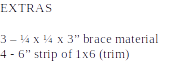
The front and back walls fit inside the side walls. Some ¼” x ¼” material is provided for additional corner support. It is suggested that these unmarked pieces be cut in half or thirds before attaching.
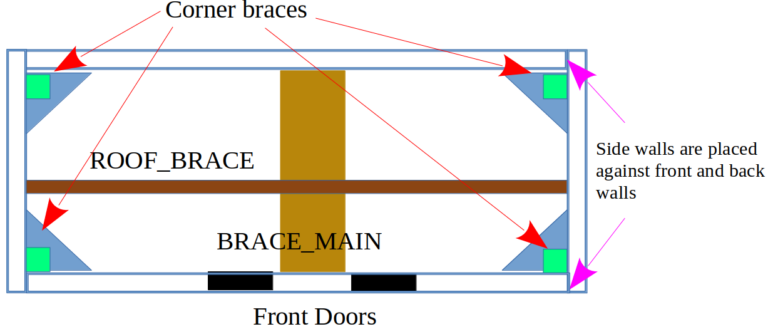
The brace pieces add strength, lessen warping, and assure proper spacing. Cut sections of the 1/4″ brace materials to fit into the corners. Make sure the brace will overlap the wall and foundation.
Triangular corner braces are also provided. If so desired, these may be placed in such a manner as to support the second floor. However, the interior is not designed to be visible and the material for a second floor is not included. The braces should still be used but the vertical placement is not critical.
BRACE_MAIN will fit between the front and back walls – it is laid flat and centered above the foundation and between the doors but vertical location is not critical. There are also several 45º corner braces to be placed in the corners. These braces may be placed at a level suitable for supporting a second-story floor (not included) if desired but the interior is not intended to be viewable.
With the two corner sub-assemblies combined, add ROOF_BRACE between the side walls. Make sure to leave clearance for the chimneys – the brace should not be at the peak. (or cut a slot in the chimney to accommodate the brace).
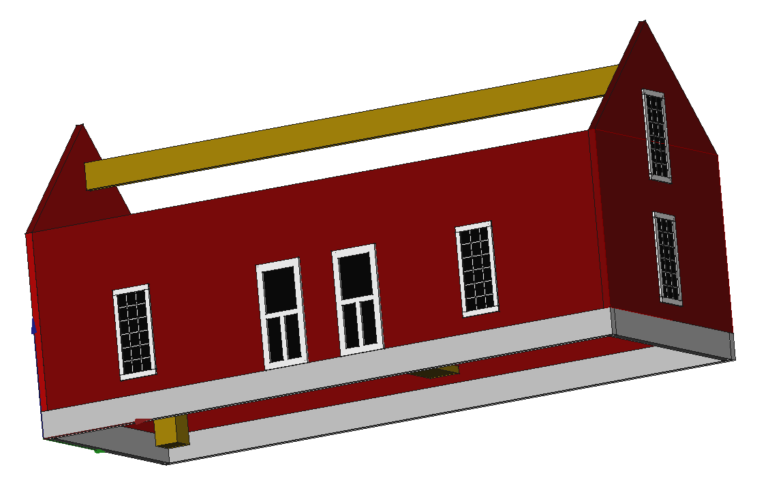
At this point, the structure should look something like this from the front – assuming the walls are painted with windows and doors installed but no trim.
PART 2 – REAR STRUCTURE – The vertical part of the “T”
[Note the base of this section is level with the bottom of the foundation of the front structure. The prototype yard slopes toward the front; the foundation is exposed in the front and sides but ground level at back.]
A similar procedure as that of the main structure is followed. There are no foundation sections and one wall is only a blank guide with a centerline etched in. (This piece is not visible. It is large enough to use as a base to experiment with various finishes for this wood).
Fasten WALL_BACK_GUIDE to the rear wall. Alignment markers are etched into both pieces. The WALL_BACK_GUIDE bottom is flush with the foundation bottom (the rear structure does not have a visible foundation). The top of the guide should align with the bottom of the slots in the rear wall.
When this section is complete, it lines up to the center of the back (slotted) wall of the main section. The slots are for the roof sections of the back section. With the left hand section of the back roof temporarily in place, slip the peak to the guide wall to the appropriate place of the main section and glue in place. Wood glue and clothespin clamps work well here.
Looking from the top:
The side walls of the rear section are placed on the outside of the back guide
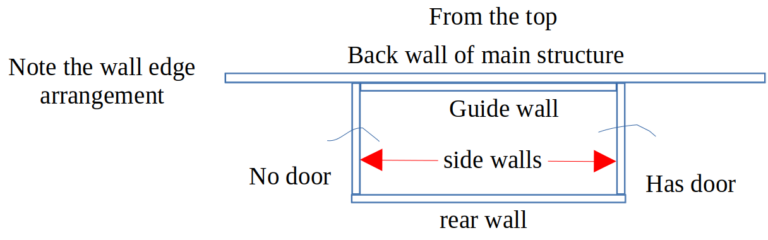
The right side wall has the door opening placed toward the rear. The left side wall has no openings. BRACE_BACK will fit between the walls. The rear wall fits across the side walls as shown above. The 45º corner braces can be used between the side walls and rear wall.
If the etched boards on the walls are not to be visible, these side walls are reversed: the door side is on the left, the no-door side is on the right.
Continuing on …
SUB_ASSEMBLY 3 – ADDITIONS
At some point, additions were added to the rear section of the house.
Fasten the long and short walls together as was done with the previous walls. Braces are provided which will act as spacers for each side. With the braces against the main back wall, fasten the addition sections in place. Clamps and weights come in handy.
Fasten BRACE_ADD_L to the right side (from rear) of the main structure rear wall and BRACE_ADD_R to the left side rear wall of the main structure. The etched lettering will face the rear wall.
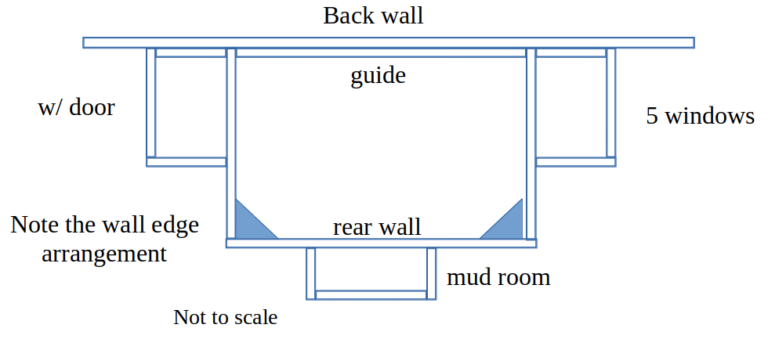
There are labeled braces for each addition and the mud room.
Again, if the etched boards on the walls are not to be visible, these additions are reversed: the 5-window addition is on the left, the addition with the door is on the right.
STEP 4 – TRIM
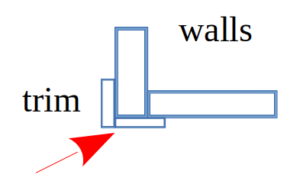
Once the walls are in place, the trim should be added. Note the walls are a scale 5.4” thick – a scale 1×6 is not quite sufficient so the trim is built from the included 1x8s. The trim is placed such that the wall edge is covered and the non-edge side overlaps the end.
SUB_ASSEMBLY 5 – ROOFS
The roof sections are a bit over a model 5″ thick … enough to presume enclosed rafters.
The prototype roof is now modernized corrugated metal; it was originally a shake roof – being located in a lumber mill town. It was not a premium dwelling but it’s doubtful it had a tarpaper roof – though in that place and era, maybe it did. One of the pre-production mock-ups had a tarpaper roof but being is the house was built in a lumber town, wooden shingles would be more appropriate.
There are too many individualized choices available, so roofing material is not included. Wild West Scale Models has a nice selection of shake roofing; other possibilities exist depending on the modeler’s preference.
Place the rear sections of the roofs first. They fit into the slots in the rear wall. It may be beneficial to bevel the back section roof edges to a 60º angle (the front roof sections meet at a 90º angle). Roofing material will cover any small gaps between the roof pieces if the edges are not sanded.
Once the rear roof sections are in place, the main roof sections are placed; the rear section first, then the front section. These sections join at a 90º degree angle; the front section overlaps the rear section
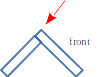
The holes for the chimneys should line up …
The other roof sections may be added at this time. Bevel edges are desired. It’s best if the trim has already been placed.
There are three pieces to the back section roof. Temporarily place the two sections with the square holes into the slots of the back wall. The holes are at the top; the notched section is the right side section. The third piece fits over the right-side addition at a different angle than the main section. That piece fits up against the wall and acts as a spacer for the main sections. The notch fits the addition section and the left hand section lines up with the rear edge.
The left side addition roof fits in place at the same angle as the main roof.
The mudroom roof fits directly on the mudroom walls. Make sure the roof is centered.
If not done already, place the doors and windows.
The chimneys should now be placed. If the roof beam has been placed appropriately, there should be no problem with clearance.
Roof covering is up to the modeler. The prototype had shake shingles; later asphalt, now corrugated metal. Corrugated tin may be used; one of the kit prototypes used “tar paper” as covering. Wild West Scale Model Builders is one supplier offering a nice set of shake shingles – the kit prototype used similar but different colors on the main and rear sections – WildWest #2 and #8 – but of course, the choice is the modeler’s.
Step 6: COMPLETION – PORCH
At this point, the model should be placed on a base. The porch sections are stacked and placed centered against the front wall foundation. Like the prototype, the top step does not line up with the front doors thresholds. However, the height may be adjusted as desired.
The porch roof requires some fiddling. The porch roof has a tab that fits the slot in the front wall. This section and the two wings need to be beveled so that a proper fit is obtained. The porch roof covering should match that of the main house section.
There are 5 porch columns on the prototype: one is centered between the two doors with the base on the lowest step. There is a column at each side of the porch roof with bases on the “ground” and two more centered between the center post and the wing posts placed at the edges of the bottom step.
The structure is now be ready for placement, scenery, and desired weathering.
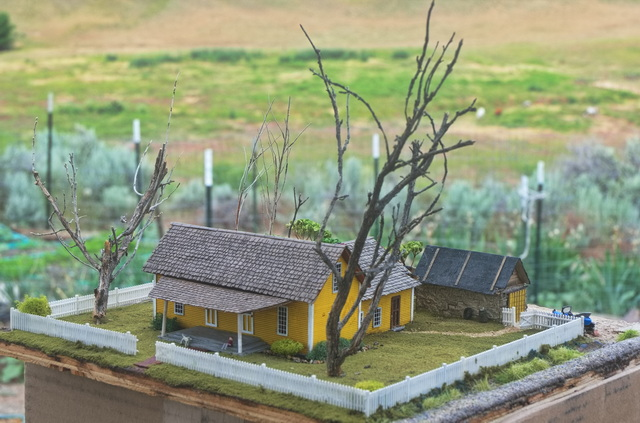
there are differences from the kit version.
1st Critique:
I have everything done just got shingles for the roof am going to experiment on a piece of of wood to see how I want to weather the shingles,. The kit was enjoyable to build. There was no mention in the instructions for the porch so I glued it on and then looking at picture I noticed the supports for the sides of the roof in checking parts list I see the ends of the roof. I did not find anything labeled for that. I also found the roof for the addition was too wide I cut it to get a reasonable overhang. I did enjoy the building of this kit and the result was good. I particularly liked having the braces for the inside to keep everything straight and in the corners. I expect to get the shingles on the roof in the next couple days. It would have been done already but I cracked one of my lumbars in the back. When get the roof finished I can send you pictures if you want.
I believe I’ve corrected the porch issue.
Window Glazing
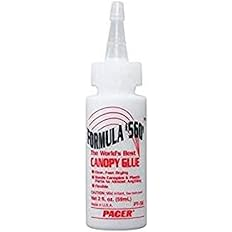
Glazing the windows will be the modeler’s choice. One method I use if the interior is not visible is to cover the individual panes from the “inside” with Formula 560 Canopy Glue. It looks sloppy at first but cures semi-clear; it has that “old-time” glass look. Not an endorsement; just a method I use.
Tarpaper Roofing:
Find some unembossed thin paper towel material: I’ve used tissue and toilet paper. Toilet paper is pretty flimsy and doesn’t tolerate “wet”. Grocery bags are a bit too thick but could be used.
One way or another, this paper is going to end up (probably) black. It can be colored ahead of application or stained/painted after. One suggestion would be to spray paint the material in the desired color ahead of time. The roof base of the model can be stained/painted a desired wood color. This would underlay the “tarpaper” and would show though any weak spots in the tarpaper as the wood it would be on the prototype.
The tarpaper is cut into 3ft wide strips and laid crossway starting at the bottom and working up with a slight overlap. A thin strip – maybe 12″ wide – is laid lengthwise across the cap of the roof.
The present structure has a roof of gray corrugated metal with 12” ribbing.
The original structure had a shake roof. Wild West Models is one manufacturer that provides shake roof material.